Film Review: A Ghost Story (2017)
Director & Writer: David Lowery
Genre: Supernatural
Format: feature film
***Spoilers ahead***
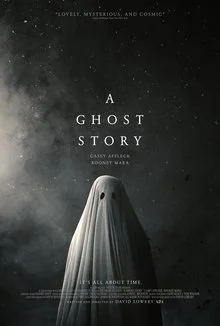
A Ghost Story is about a man who becomes a ghost, tethered in place to the last house he lived in before he died. While the film has a shockingly simple premise with scant dialogue and even less plot, this atmospheric movie packs a devastating emotional punch.
Shot in boxy 1:33:1 aspect ratio to emphasize the claustrophobic nature of the titular ghost’s confinement—both within physical space and within his grief—the cinematography conveys a constant sense of tension and distress even in the most poignant moments. It is astonishing how well Casey Affleck is able to convey his character’s anguish while engulfed in a white sheet with gaping black holes for eyes. Although we never see the actor’s actual eyes once he becomes a ghost, never mind his face or the rest of his body, we still cannot help but feel the torment of the passing years as he lingers, mostly ignored by the living, forced to passively observe those around him, including his beloved wife, who eventually tries to move on with her life.
While this film could’ve remained a simple rumination on loss, it engages with several other existential themes as the ghost continues to exist within the house that becomes home to various others, including a motley crew of rabble-rousers. During an esoteric party, the revellers engage in a philosophical debate on the meaning of life and the futility of creative pursuits.
One of the most chilling scenes involves our ghost and a neighbor ghost watching each other through their respective windows, soundlessly communicating via specter-telepathy. Neighbor-ghost says, “I’m waiting for someone.” Our ghost asks, “Who?” to which neighbor-ghost responds, “I don’t remember.” In a later scene, the ghosts once again regard each amid the rubble of their bulldozed homes when neighbor-ghost says, “I don’t think they’re coming” and promptly disappears, leaving our ghost bereft once more.
Here the film takes us on a journey through time, showing us our ghost still haunting the same land several years—possibly centuries—in the future, as he stands on the edge of a skyscraper over-looking a futuristic city before plunging off the roof. Having fallen through time, he witnesses the history of this particular spot from the arrival of a pioneer family and subsequent deaths by Native Americans (the only scene I didn’t love in this story since it presents a rather one-sided view of the issue of colonialism within a narrative that otherwise seems to interrogate the concepts of legacy and memory) until he sees himself alive with his wife.
In the opening scene of the film, one of the very few scenes with actual dialogue, our ghost’s wife describes how as s child who moved around a lot, she always wrote down a little note and secreted the fragment away somewhere in the house before leaving, as a souvenir of her having been there. This is something we see her do before she leaves the house she shared with our ghost, a note he has been trying and failing to extricate from the timbers, which seemed impossible after the house’s demolition. He is given a second chance after his fall through time, however, and the film ends when our ghost finally manages to pry the note from the wall. Upon reading the message, which the audience never sees, he disappears, leaving behind nothing but a stained sheet.
The film’s tense atmosphere owes a lot to its impeccable score composed by Daniel Hart (who has most recently been lauded for his work on Interview with the Vampire and the much anticipated upcoming third season, The Vampire Lestat). The song I Get Overwhelmed by Daniel Hart and his band Dark Rooms provides the perfect anthem to a whimsical, heartfelt story that is as eerie and unsettling as it is tender and philosophical.
This is a haunting film, both literally and figuratively, for those who enjoy slow pontifications rendered one exquisitely introspective frame at a time.
Review By Xan van Rooyen