

Film Review: A Weeknd Stan Reviews Hurry Up Tomorrow
I’ll state my bias up-front: I’m a Weeknd fan.
I love his Siouxsie-and-the-Banshees-sampling early work, and the macabre sensibility that pulses through even his most radio-friendly singles. His unnerving concept albums play like radio broadcasts from purgatory, and songs like “Gasoline” and “Baptized in Fear” are sinister sketches that build tension with every line. I even liked The Idol, his reviled HBO dramedy.
So, I was more excited than most for Hurry Up Tomorrow, his sort-of-horror film adapting his new album of the same title. I didn’t believe the reviews. Assumed the 15% Rotten Tomatoes score was just anti-Canadian sentiment, or a populist desire to see a superstar fail.
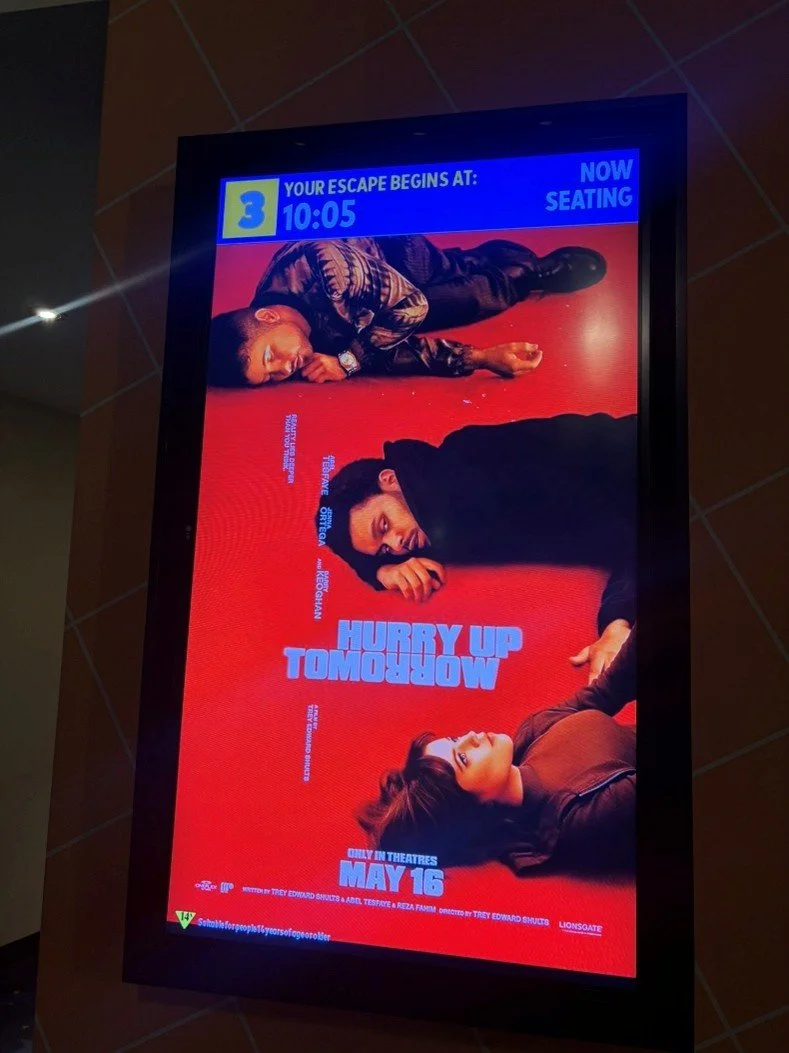
Hurry Up Tomorrow isn’t inept by any means. Directed by Trey Edward Shults, it boasts a stacked cast including horror vets Jenna Ortega, Barry Keoghan, and Riley Keough, with the Weeknd (legal name Abel Tesfaye) starring as himself. (For clarity, I’ll refer to his character as “Abel,” call Tesfaye by his last name when talking about his performance, and use his stage name in reference to his music and public image). There’s a lot of talent and care on display; unfortunately, the movie suffers from an unfocused, undercooked script that plays things disappointingly safe. It’s not as interesting or unpredictable as The Weeknd’s best music videos and lacks the gleeful trashiness of The Idol. As a fan, I found it entertaining but rarely truly exciting.
For most of its runtime, Hurry Up Tomorrow alternates between Abel, a troubled R&B star struggling to continue his tour after a bad breakup, and Anima (Jenna Ortega), an obsessed fan with a destructive temper. After a disastrous show, Abel runs away with Anima, taking her on a cute date that culminates in a one-night stand and an ill-advised mutter of “Never leave me.” At this point, Hurry Up Tomorrow finally turns into a thriller.
Unfortunately, this was also the point where people in my theatre started to laugh at the movie.
The scene that provoked this reaction (depicting Abel and Anima’s first argument) had already gone viral online, with many users mocking Tesfaye’s limp line delivery. But here’s the thing – in context, his performance works. This scene is not supposed to be an emotionally powerful confrontation – it shows a self-absorbed rock star giving the brush-off to a groupie he met a few hours ago, whose behaviour has suddenly become disturbing. Tesfaye’s befuddled, emotionally immature reaction fits the situation.
The Weeknd is not a bad actor. He’s just so good at playing repellent lowlifes that you can’t watch him without experiencing second-hand embarrassment. Both here and in The Idol, he’s well aware that his characters are charmless and kind of pathetic.
Despite the “vanity project” accusations, Hurry Up Tomorrow is more masochistic than anything. The whole point of this movie (and a recurring theme of the Weeknd’s oeuvre) is that Abel is incapable of maintaining anything other than fleeting, surface-level relationships; beneath his callous stage persona is a wounded vulnerability that is itself a façade. Tesfaye plays Abel as alternately doleful and petulant, his teary-eyed expression equal parts genuine anguish and manipulative self-pity. I found his performance consistently compelling.
In contrast to Tesfaye’s less conventional style, Ortega provides a steady hand at the wheel, her classic stalker-villain performance making the best of a script that can’t decide whether her character is insightful or just insane.
This identity crisis is the real problem with Hurry Up Tomorrow, which struggles to tell the (darkly hopeful) story of the companion album while still functioning as a horror flick. “Baptized in Fear” notwithstanding, Hurry Up Tomorrow is the Weeknd’s least horror-adjacent record, a straightforward story of excess, alienation, and repentance. And the movie is a jumble of tones, packed with daring artistic choices that inadvertently undercut each other.
Take the main set-piece: a concussed and confused Abel tied down to a hotel room bed, as an unhinged Anima blasts his old singles from her phone, interrogating him about the dark themes and hidden meanings in the lyrics. I suspect whoever wrote this scene (Tesfaye, Shults, and co-producer Reza Fahim share credit on the screenplay) meant this to be an emotional turning point for Abel’s character. But Anima’s analysis of the songs is so surface level (“Blinding Lights” is about isolation? Who knew?), it’s more funny than profound. And the actors play it as such: Ortega wide-eyed and triumphant, Abel aghast and uncomprehending. (Tesfaye’s expression throughout is a perfect hybrid of distinct miseries; his mortal terror has a delicious undertone of I can’t believe I have to listen to this right now). Embracing black comedy, this Clockwork Orange-lite interaction is supremely entertaining on its own terms. But it chafes against the rest of the film, which gestures at a more profound inner journey for its star.
The other horror sequences could have come from a totally different movie, but are effective nonetheless. In addition to the deranged kidnapping and a gratuitously grisly kill, genre fans are treated to a lavish liminal spaces-style dream sequence, culminating in a parking garage elevator that descends ever-so-slightly too far. Loved it.
I do believe the Weeknd has it in him to make a good horror film. He obviously knows his way around the genre - his lyrics are littered with references to “Nightmare on Elm Street,” “The Hills Have Eyes,” and “Eyes Without a Face.” His songwriting shows a flair for macabre titillation and mounting dread, his explorations of cruelty and excess bordering on gothic. If nothing else, with Hurry Up Tomorrow he’s proved himself a capable scream king.
I can’t help but think if the filmmakers had leaned into the musical format, they could have crafted a surreal sonic nightmare worthy of The Weeknd’s body of work. But the songs aren’t featured prominently enough for Hurry Up Tomorrow to pass as a concert film or even a concept album movie. Instead, it manages to perfectly capture the experience of listening to a Weeknd album while staring out of a car window.
Which, I mean - there are worse ways to spend an hour-and-a-half. Visually impressive cinematography, with dynamic camerawork reminiscent of those 3D virtual reality rides, keeps the energy up even when the plot meanders. The eerie synths of Hurry Up Tomorrow (the record) work incredibly well as film scores; I was also pleased they fit in a full performance of “Wake Me Up” during the concert sequence. While I was hoping for something different from this movie – more shock, more surrealism – it’s ultimately a solid showcase for the Weeknd’s music and his long-running thematic fixations; a subdued and neurotic mirror image of The Idol. I suspect fans will come to look on it fondly.
Review by Madison McSweeney
Twitter: @MMcSw13
Instagram: madison.mcsweeney13