Celebrating Horror’s Past: Through Blood Tinted Glasses Review - Dracula (1931)
Directed By: Tod Browning
Genre: Horror
Format: Blu-Ray
It has been way too long since I first watched the 1931 Dracula. I forgot how much it butchers the story, but what I didn’t forget was the sheer joy I got from watching it.
Welcome to Through Blood Tinted Glasses, a new series where I go through as many English language vampire films as I can (with some exceptions). This is the starting point, because either the ones before Dracula are lost, incredibly difficult to get, or are not English language (because I needed some other way to narrow the list down). Yes, I know this means skipping over Nosferatu, among others, but by no means are these being discounted. The other aspect of this series is that each ‘film’ gets two parts – a review, followed by an article/essay that does a bit more of a deep dive into vampires and the way they’ve changed over the years. And yes, I refuse to call it only an essay, because it’s been a long, long time since I’ve written them, and it might take me a while to get back into the swing of things. But I’d be very glad for anyone who wants to join me on this journey!
Reviews will always appear on this site first – the article/essay will follow, initially as a (free!) Substack post on the same day, then with it following on the site a few days after. So please subscribe to Substack if you’re interested in the essay side.
“Children of the night. What music they make.”
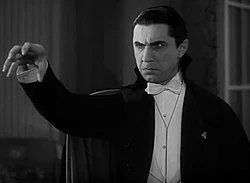
Dracula opens in a small village, where the villagers are preparing for the arrival of a coach. And here it comes, rattling over the mountains. With the coach arriving, one man explains his luggage should be left, as he is travelling onwards. The villagers gasp and try to prevent him, due to ‘Nosferatu’ stalking the mountains. But he is insistent. If you know the story of Dracula, you know this scene. However, if you haven’t seen this particular film, you might be surprised at exactly who the gentleman is arriving at Dracula’s castle so late at night.
Here is the first big change from the book – it’s not Jonathan Harker who arrives at the castle and converses with the mysterious count, but Renfield, and he is soon under Dracula’s thrall.
Other changes worth mentioning: Lucy has no suitors. We don’t really get much of Lucy, which is a shame. Instead, Dr John Seward is now Mina’s father. Mind you, we’re never told he’s not currently trying to woo Lucy – she’s simply there as seemingly Mina’s friend, and there’s no Mrs Seward around. So, make of that what you will. Lucy’s role is reduced, while Renfield’s is increased, becoming more of a prominent character. Events are, of course, condensed, and rather than a carriage chase to get to Dracula before he reaches his castle, the climax involves Harker and Van Helsing travelling across one property to the next to rescue Mina.
This version of Dracula was adapted from the play, and you can tell it’s kept the play intact – the staging, the way characters interact, the specific scenes that play out are all designed for the stage, but with a ‘wider’ view on the screen. I think many of the choices that go into making the film a little stagey were either due to the adaption or the limits of technology at the time, and they make it endearingly charming.
You can also see the way this film shaped and influenced adaptions of Dracula that followed, even where the adaption sticks closer to the book. And for its faults, the things the film does well, it does brilliantly well. The use of shadows and lighting work to emphasise Dracula’s monster status, especially where the book uses red as a motif; unable to translate to a black and white film, instead we get moments where Dracula’s face is shadowed, or the use of white to show a character’s purity – we see Mina in white nightgowns, the colour of her clothing darkening as she comes more and more under Dracula’s thrall.
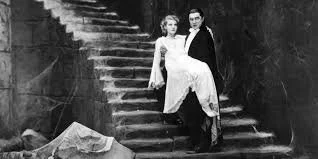
There are some moments which, I imagine, maybe thrilled audiences when this first came out, but which are unintentionally hilarious to a modern-day audience. Both possums and armadillos live in Dracula’s castle. We never see Dracula transform, but we get a glimpse of him followed by stagey bats flapping wings in doorways. It feels like parts of the film lean on the aesthetic of the Victorian setting of the book, while others are more in line with the film’s present-day. It is, in parts, a bit messy, but of course it is – the film is now nearly 100 years old, and ultimately, for a near-centenarian, it’s good.
The technological limits make it all the more impressive with what they were able to achieve, and the use of lighting and shadows combined with the acting from all involved (including the hammy Martin) make it a good film, even where the script is unintentionally funny or it veers off a bit. It’s a classic, and it remains so.
This was, I think, a great film to start with. It’s one I knew I’d enjoy, and one which adapts from the most famous of vampires. If you haven’t yet seen it, I urge you to do so. You won’t be let down.
“The blood is the life, Mr Renfield.”
Rating: 8/10 Fangs
I own this film as part of a Universal Classic Monsters collection, but if you’re in the UK, you can rent it via almost any streaming platform. You could, however, treat yourself and purchase the Blu-Ray, allowing you to indulge in the extras.
Next Up: The Vampire Bat (1933)
Some of the films I’m planning to watch aren’t easily available on streaming, but I do have a wish list with films and books to support this series. You can check it out here if you’d like to support Through Blood Tinted Glasses, or if you’re just curious at the films that’ll be coming up in the future.
Review by Elle Turpitt
Twitter: @elleturpitt
Bluesky: @elleturpitt.bsky.social