Celebrating Horror’s Past: Film Review - The Halfway House
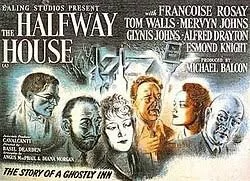
The Halfway House is an understated Welsh classic, and the epitome of cosy. I only recently became aware of its existence through it being referenced in an audiobook I was listening to (Ghostland by Edward Parnell, if anyone’s curious).
Produced by Ealing Studios, directed by Basil Dearden, and released in 1945, towards the end the Second World War, a motley group of travellers from all walks of life happen to converge on a small inn deep in the Welsh countryside. There’s just one thing… this inn supposedly burned down a year beforehand, with the landlord’s family still inside.
Our cast comprises the innkeeper Rhys and his daughter, Gwyneth, played by real life father and daughter Mervyn and Glynis Johns (the latter perhaps best known to an international audience as Mrs Banks in Disney’s Mary Poppins). There is also David Davies, a talented young musician dying of an unnamed illness, couple on the verge of divorce Richard and Jill, along with their teenage daughter Joanna, who is determined to reconcile them. Then an older couple, merchant Captain Meadows and his French wife Alice, who are driven apart by grief for their son lost in the war. Then there is Margaret, newly engaged to her Irish fiancé Terrence (I will note that there was no attempt at an Irish accent by the actor, though that may be for the best). Finally, we have Fortescue, a criminal expelled from the army and newly released from prison, and his associate, Oakley.
It was lovely to see the film open with a still familiar shot of Cardiff Castle, and to hear the first spoken line: “Diolch yn fawr, bob un” (“Thank you, everyone”). A couple of dodgy accents and random outburst of Sosban Fach aside, there was something very gratifying about seeing the film embrace its Welsh setting, to the point I will admit I may be slightly biased in its favour.
It is sweet though, as our characters arrive at the halfway house to take a little break from real life, so do we the audience. It brings to mind childhood summer holidays in the countryside, where the endless rolling hills and fields felt like their own separate little world. There is no real attempt made by the filmmakers to hide that Rhys and Gwyneth are ghosts, so I won’t bother. The tragedy of their situation tinges the edge of the story, but their role is to highlight that the living need to embrace what they have and live well while they can, a message delivered with the kind of optimism only found in stories made in wartime. The war is still there, not a single character unaffected by it, but they have found their much-needed reprieve.
The atmosphere is, for the most part, warm and humorous, but it never forgets that it’s telling a ghost story. There are a few moments that abruptly switch to the eerie, and sent a genuine shiver up my spine.
I want to make clear that for as much as I enjoyed The Halfway House, it is very much British wartime propaganda. You don’t watch an eighty-year-old film and not expect it to be dated in many respects, but it’s worth remembering that the values of the time are reflected in it, and it can be uncomfortable for the modern viewer. There’s a scene of domestic violence played for comedy, as well as several cringeworthy moments of different characters lecturing an Irishman about why he should support the British. It’s an old-fashioned, albeit feel-good, morality play.
I maintain however, that this is a gem, and entirely family friendly. If you want something low-key but with spooky vibes or themes to relax with your loved ones these dark winter months, The Halfway House is an excellent choice. I can see myself returning to it many times in future.
Review by Dai Baddley