Through Blood Tinted Glasses Review - The Vampire Bat (1933)
Read: TBTG Introduction / Review: Dracula (1931)
Directed By: Frank R. Strayer
Genre: Horror
Format: Streaming – Pluto
This is, honestly, a strange little film, but oddly enjoyable. The villagers in a German town start dying of blood loss, and the town fathers gather to discuss the deaths. Among them is police inspector Karl Brettschneider (Melvyn Douglas), who insists against the supernatural, and is determined to discover the human killer. Meanwhile, Dr Otto von Niemann (Lionel Atwill) visits patient Martha after she has been attacked by a bat. While there, she is also visited by Herman Gleib, played by Dwight Frye – aka Dracula’s Renfield. The film also features Fay Wray (of King Kong fame) as Brettschneider’s love interest, and character actress Maude Eburne, as comic relief Aunt Gussie.
Welcome to Through Blood Tinted Glasses, a journey through English language vampire films. We started with Dracula (1931), and each film will be accompanied by a review and an article/essay. This is the second film in the series, and if you’d like to read the article that goes along with The Vampire Bat prior to it being on the website, make sure you subscribe to Substack.
The below contains spoilers
“Goodnight, gentlemen. Don't let the vampires get you.”
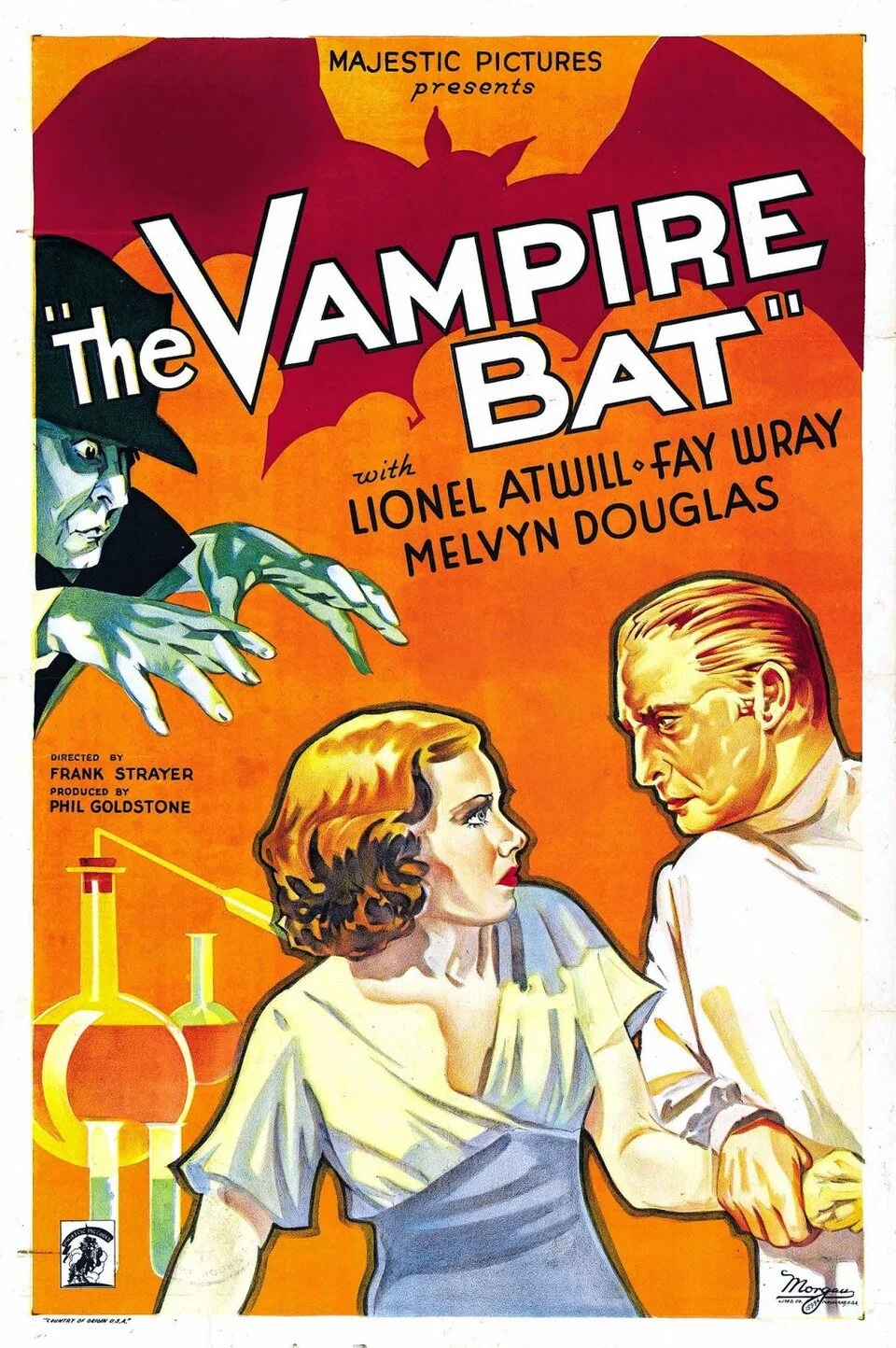
I have to admit, there’s not much in the film that’s completely clear. But maybe this is the result of watching it almost 100 years after release: as part of the ‘modern’ audience, we could, perhaps, be too used to being spoon-fed explanations. Very little is explained in the film, and instead, a lot is left up to the watcher to put together via context clues. It’s not even clear what Brettschneider’s role is initially, but he comes across as very authoritative and as a leader, so it’s easy to trust him as a main character (turns out he is in, in fact, a police officer. The only one in the village apparently).
Fay Wray and Maude Eburne live with the doctor, or he lives with them? Their relationship isn’t clear, but when we are introduced to Wray’s character Ruth Bertin, she’s conducting some sort of experiment. Aunt Gussie is wonderfully entertaining; a hypochondriac who seems to have experienced every ailment under the sun. What I particularly liked about these two women is they never feel sidelined. Gussie is there to give audiences a laugh (especially at the end – we’ll come back to that later!), but everything is done with a bit of a wink and a nudge to the audience, with the doctor often accurately diagnosing her with medical terminology sometimes too much for her to fully grasp, but which Ruth understands (and which usually ends up being something along the lines of, you have a beating heart). Eburne really plays well off everyone in the cast, and there’s a delightful scene with her and Dwight Frye in a garden, while everyone else is looking for him.
Dwight Frye’s Herman is portrayed as mentally disabled, with the rest of the villagers viewing him and his behaviours as strange. He gathers bats to keep as pets, is present shortly before Martha’s death, and survives by stealing food. The other characters are distrustful of him, and when one man puts forward the idea Herman might be the vampire, others latch onto it, eventually even convincing Karl this might be the case. It adds an element of sadness to the story, but watching it, I was very much struck by how sympathetic the film is to Herman, especially when he is persecuted by the rest of the cast. His character serves as a red herring, but one who hasn’t actually done anything wrong. A mob mentality takes over, leading to Herman’s death. While the others celebrate this, thinking the nightmare is now over, another death takes place.
By this point, we have seen what’s really happening – it is, instead, the good doctor who is causing these deaths. He may or may not be a vampire, but he is controlling his assistant, directing him via long-range hypnosis. No, this is never explained, either. The film takes a different turn here, leaning away from the supernatural vampire (like Dracula) and towards science as the monster (more inline with Frankenstein), as Niemann has created/discovered a strange form of immortal life, a blob in his lab which he must feed with blood.
The film definitely isn’t shy about the Dracula and Frankenstein inspirations, yet it works, finding a balance between the superstitious townsfolk and the evil scientist, and creating a middle point in Karl Brettschneider. Science is used for evil, and details are kept deliberately vague, but we get the gist, even alongside Aunt Gussie’s complete faith in science, medicine and the doctor. It still retains some of the ‘stagey’ elements from Dracula, but manages to be its own beast.
The ending takes a dramatic turn, too – Brettschneider is encouraged by the doctor to go home and sleep, and he gives him pills to assist with this (though we, as the audience, see these clearly labelled as poison prior to them being handed over). With Herman dead, Dr Otto von Niemann knows it’s only a matter of time before the deaths are linked back to him by Brettschneider, so he looks for a way out. He once again enlists his assistant to go get Brettschneider, intending to feed him to the blob, but once in the lab, Brettschneider throws off his disguise, revealing he never took the pills, and pulls a gun on the doctor.
It's a fun moment, waiting to see what happens, knowing Brettschneider will find a way out of the mess. Ruth adds tension, after she realises the doctor has been up to something and he’s dragged her into the lab. What follows is a bit of standoff, before the doctor throws his assistant under the bus and the assistant holds him up, allowing Brettschneider and Ruth to escape. Gunshots are heard, and both our heroes poke their heads back in to find a scene of murder-suicide, the living blob destroyed, and all’s well that ends well.
This moment is emphasised by Gussie coming to find the doctor, our heroes protecting her from the sight, and Gussie rushing off with a bad stomach. The film literally ends up with our heroes laughing at her, right by the door leading to the two dead bodies.
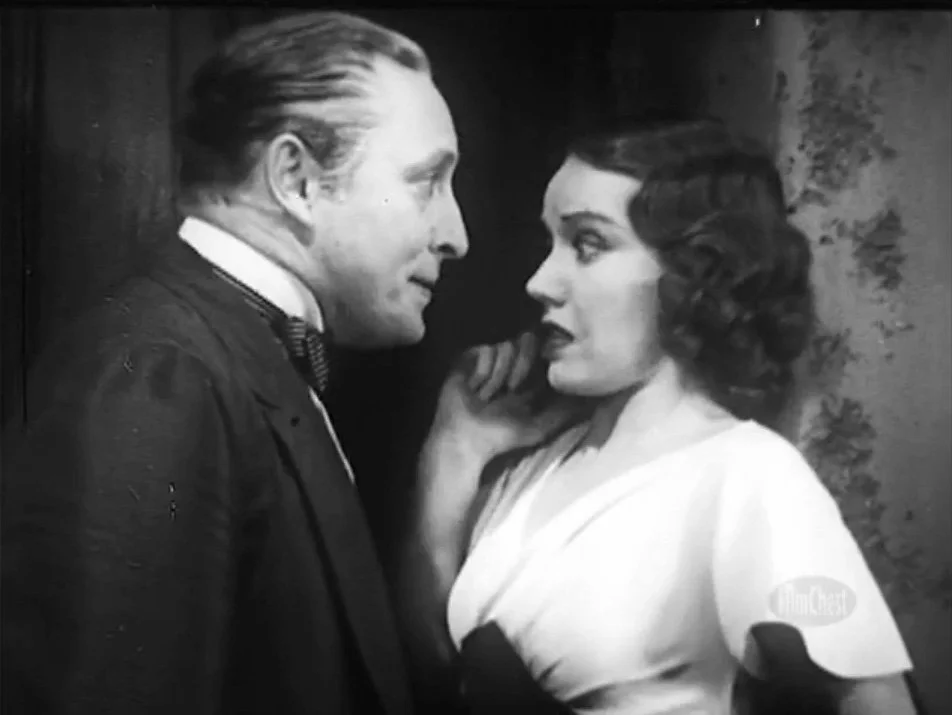
The film is, honestly, a gem, and an undervalued one. It very much pinches from other films of the time, while doing something ever so slightly different. The plot just about holds together, with enough holes for a graveyard, and the acting may lean a little towards hammy but it works. It has enough tension for such a short film, and though underexplained, there’s nothing here that left me feeling underwhelmed. If you’re a fan of the classic, black and white horrors, it’s worth checking out even just for the novelty factor.
Rating: 7/10 Fangs
The Vampire Bat is available on multiple streaming platforms, though I watched it on Pluto, which is one of the few places you can stream it in black and white.
Next Up: Mark of the Vampire (1935)
Some of the films I’m planning to watch aren’t easily available on streaming, but I do have a wish list with films and books to support this series. You can check it out here if you’d like to support Through Blood Tinted Glasses, or if you’re just curious at the films that’ll be coming up in the future.
Review by Elle Turpitt
Twitter: @elleturpitt
Bluesky: @elleturpitt.bsky.social