Book Review: Down in the Sea of Angels by Khan Wong
Genre: Sci-Fi
Age: Adult
Format: ebook
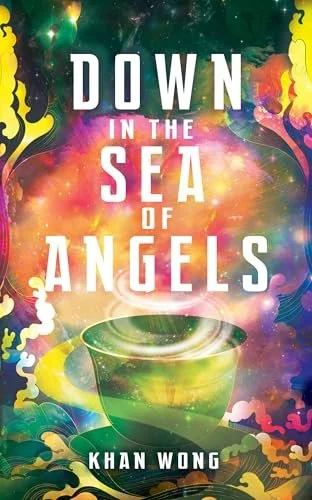
There are some interesting ideas at the core of Down in the Sea of Angels, but they’re buried in a messy package that doesn’t really hang together. The book is told through three different POVs – Maida in 2106, a psion who can see the history of an object just by touch, Nathan in 2006, a queer, Chinese American tech designer who is getting ready to go to Burning Man with his friends, and Li Nuan in 1906, a teenager who was sold and trafficked to America to pay off her father’s debts. All three are linked by a single item – a jade cup. When Maida finds the cup in a time capsule, the visions she receives are more powerful and consuming than anything she’s seen before.
Sounds pretty interesting, right? Unfortunately, the most promising of ideas here ended up being buried by…everything else. The three stories feel so disconnected, the jade cup link is tenuous, and none of them really have anything to do with each other. Maida discovers her local regional leader is stirring up hate against psions, and maybe the utopia isn’t as perfect as it seems. Although that’s not quite right – Maida’s world is presented as this perfect, wonderful utopia where everyone chips in to get luxuries and people who don’t help are seen as selfish. None of this is questioned. Neither is Maida’s constant smugness against the ‘precursors’, the people who lived before the ‘collapse’. Now, there’s only 100 years between Nathan’s timeline and Maida’s, and between that time apparently all pop culture has disappeared, so part of Maida’s job is unearthing this and discovering more of human history. It’s messy, and it feels disjointed. Characters are definitely old enough to have had parents or grandparents who lived before to the collapse. I typically enjoy when futuristic settings have nods to the past in a wink-wink-nudge to the audience type of way, but here it feels too on the nose and too much of a reach for the actual timeframe.
Maida keeps referencing how badly the ‘precursors’ messed things up, their wastefulness, their inability to be perfect and, well, she’s talking about us. Yes, our society is an absolute mess but it’s essentially repeatedly insulting the reader. Something that does bug me in utopia/dystopia narratives too is how America-centric they are – there’s plenty of references to different regions and areas with America, but nothing about the rest of the world. Which feels odd considering the books themes of harmony and union. At one point, Maida is frustrated and angry at the things anti-psions are saying about them, which is very reasonable, but she’s trying to mentally argue against it and…well, none of it is actually untrue! These aren’t lies! The psions don’t like that instead of using their particular term for people without these abilities (nul-psi), they’re using a different term (non-psion). It feels so minor and during reading it struck me that ‘nul-psi’ felt more insulting than the alternative.
“The bad people are lying and saying psions look down on nul-psis!” Except they do! We’re told they don’t, but Maida’s thoughts and the other psions actions and attitudes show they actually do. It’s messy, and that’s before even getting into the other two strands.
Li Nuan is trafficked to America when her father sells her to pay off debts. It’s 1906, and she’s trapped working for a Chinese gang boss. Her story is by far the bleakest, and felt like it contrasted with both Maida’s and Nathan’s stories in tone. It just felt like a bit much. I’m sure there was some good intent here, but the sexual abuse veered towards over the top. I’m not the kind of person who thinks this should be avoided in books, but I do think it needs to be handled sensitively and carefully, and I don’t think that’s the case here.
As for Nathan, I didn’t care about him. Oh no, Nathan’s just discovered the industry he works in is built on exploitation. He enters a spiral of regret and basically does nothing for a long while except go to Burning Man. His friend (rightfully) points out Nathan should either shut up or do something. He does, eventually, do something, but this comes after a lot of repetition about the same things and a lot of Nathan feeling sorry for himself.
Overall, although the book had promise it was a little too messy, with too much telling rather than showing, and too preachy for my tastes. It could have been really effective if it had been a bit more focused, but as it was, it felt like the past storylines didn’t really have any impact on the plot, and the three strands weren’t tied together too well.
Review by Elle Turpitt
Twitter: @elleturpitt
Bluesky: @elleturpitt.bsky.social
I received this ebook from Angry Robot via NetGalley for review consideration.