Book Review: What the Fog Conceals by R.A. Marno

WHAT THE FOG CONCEALS is a great piece of Northern Irish Gothic from debut author R.A. Marno, based on the true story (and historical mystery) of the clearance of Audley’s Town in County Down. The author does not attempt to ‘solve’ or to suggest an answer to the questions around what happened to the people of Audley’s Town, but rather sets out to remember them, and to offer a correction to the silent complicity that allowed the clearances to fade into historical obscurity.
If you are not familiar with the history of Northern Ireland, then, essentially, Ireland was invaded by the Anglo-Normans in the 1100s, and their limited piecemeal conquests laid the groundwork for later invasions and expansions. The Plantations of loyal Protestants in the North of Ireland, beginning under the Tudors and continued by the Stuarts, displaced a lot of Irish (who were Catholic) from their lands, and established an enclave there. Fast-forward through years of linguistic and cultural suppression, Anti-Catholic discrimination, the 1800 Act of Union, the forced starvation of the Irish people by the British, and the Irish struggle for independence, Home Rule in the 1920s separated the Republic of Ireland from the counties in the North who, due to the Plantations and history of Anglo-Irish rule, wanted to remain part of Britain (but not everyone in Northern Ireland agreed). Along came The Troubles, and after years of civil war, the Good Friday Agreement. Today, Northern Ireland is still part of the United Kingdom. This is incredibly oversimplified, of course, but that’s your whistle-stop tour of history in one paragraph. For more information on the Troubles, try the documentary Once Upon A Time in Northern Ireland.
The clearances of Audley’s Town in Co. Down took place in this backdrop, where Harriet, Lady Bangor, and her second husband, Major Savage-Nugent, cleared the village of Audley’s Town, where 197 people lived, and 160 of them were never heard from again. They were put onto a ship bound for the USA, but they never arrived, and simply disappeared from public record. This mystery centres on the Castleward estate, and received some media attention in 2012, when historians reopened the case to try and find out what happened to these people.
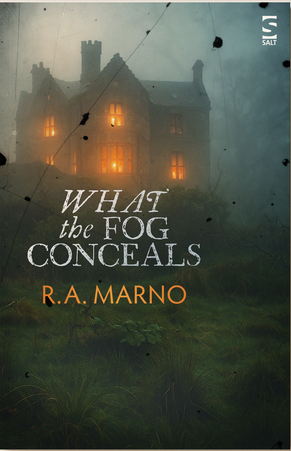
R.A. Marno’s debut novel WHAT THE FOG CONCEALS is the slow-paced, entirely and explicitly unsentimental response to this event, not attempting to sensationalize, but to memorialize. I deeply respect that approach, and I think it works well. In this novel, R.A. Marno creates a deeply moving and quietly assured narrative of unstoppable resurfacing memory, the unexorcisable haunting of history, and the ultimate, irrepressible power of a landscape - a heritage both natural and constructed - that is as inescapable as mortality.
It opens like a scene from Alejandro Amenábar’s highly influential Gothic Horror film The Others (2001), with a house surrounded by creeping mist, and a woman of steely will and tightly-wound self-control looking out over the garden into a landscape she knows well, yet cannot fully see. This in itself is a haunting image of Northern Ireland’s history, and its British and Anglo-Irish gentry, with their identities in two worlds, and their sense of belonging inextricably linked to curation and control.
The secret that Harriet wishes to conceal is not at risk of resurfacing because of ghosts, or snooping young women in diaphanous nightgowns, or strangers upending her world. The secret of Audley’s Town is not even a secret at all – it is an event that has been deliberately forgotten, consigned to oblivion, edited out of records, and suppressed in silence. Yet the land remembers the village was there, and the land remembers its people, and the memories it forces to the surface cannot be dismissed and exorcised. The memories bleed from the land into the very house that Harriet has inherited and ruled over, which is a sentient entity within the novel. Harriet’s first clues that her hold on things is loosening comes from items appearing in the house that should not be there, and the house itself being recalcitrant, the atmosphere changing, doors not opening for her as they should, and other such little acts of petty treason.
As I was reading, I was struck by the very literal way this novel, whether consciously or unconsciously, interprets Jesus’s words in Luke 19:40, which could be taken out of their original context and reapplied to Audley’s Town; He answered, “I tell you, if these [people] were silent, the very stones would cry out.” (English Revised Standard Version, square brackets mine for context).
My favourite lines in the book, and the moment this parallel with the Scripture clicked for me, came around two-thirds in, with a character called Kate, who I think was my favourite, looking back over the pages of a journal she has started:
The first few pages were blank, as if she hadn’t known how to begin. Then came a fragment of memory — a line she had written in the kitchen late one night, long after the lights had gone out, when the fog had crept under the door like a rumour. “They want us to forget, but the earth doesn’t.”
This is a novel about dealing with a history that refuses to be suppressed any longer, and facing the consequences of a complicit, collective silence, together. This is not just Harriet’s burden, it is also something that the remaining villagers must face, and find ways of moving forward with the memories, rather than trying to bury them. The land remembers for those who forget, and there is no way to edit, curate, or silence the very land you live on. Within the context of a partisan history, I personally felt the ending, and Marno’s way of drawing these lives, responsibilities, and plot strands together, was a satisfying, community-focused one, that looked forward to new ways of living and reckoning with the collective past.
There are some moments of circular thinking and repetition which muddied the picture rather than clarified it for me as I was reading, but the needle only skipped a couple of times, and overall, I found the prose and the inevitable march of revelation ultimately satisfying and deeply emotional.
The gradual return of sound and speech to the remaining villagers – “not all in English” – hit me most, and some lines gave me real pause. It is difficult to sustain a tone of quiet dread through the clockwork tick of story beats, but I think Marno manages this well. I would say that this debut is not only a wonderful addition to Northern Irish Gothic fiction, but a must-read for all those who love slow burn Gothic Horror.
Purchase at Salt Publishing / Amazon / Foyles
I received an ARC from the author, ahead of its release in August 2026 with Salt Publishing.
By C. M. Rosens
Instagram, Threads, TikTok: @cm.rosens
Bluesky: @cmrosens.com