

Book Review: Kindred by Octavia E. Butler
Genre: Historical Sci-Fi
Age: Adult
Format: Paperback
I have been a fan of Octavia E. Butler’s writing for years. Her Lillith’s Brood trilogy, Parable duology, and final novel Fledgling are all favorites of mine in the sci-fi genre. They are not difficult to read but the themes within push readers to confront complex topics led by murky characters. Kindred is no exception and this is likely why it is chosen for book clubs as well as assigned readings in some high school and college courses.
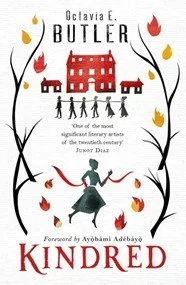
Butler’s 1979 book follows the account of Dana Franklin, a young African American woman from 1976 Los Angeles, as she is suddenly and inexplicably whisked back in time to an antebellum plantation in Maryland. This unexplained time travel wrenches her out of the present anytime her ancestor and the heir to the plantation, Rufus Weylin, is in mortal peril. Dana must confront the danger of chattel slavery, her opinions on Rufus as he grows from boy to man, and ensuring she preserves her family lineage on each subsequent trip to the past.
One of the many things I appreciated about this book is that categorizing Kindred to one genre is nearly impossible. It has elements of both sci-fi and fantasy, but Butler considered it more like a grim fantasy than a traditional science fiction novel. The book also provides an account of slavery that clapped back at popular narratives at the time. In the 70s, and sadly, today as well, some people believed that enslaved people were ultimately submissive and had little to no personality of their own. Kindred used Dana’s first-person narrative to showcase the other enslaved characters on the plantation who each have their own story and personality, even for minor characters with little time on the page. The book shows how Rufus’s father, Tom Weylin, and then Rufus himself would leverage selling or not selling an enslaved person’s children to keep them from running for freedom or more likely to work hard. How characters like Dana’s ancestor, Alice, started life as a free woman but ended up enslaved after marrying an enslaved man and trying to help him escape. How men like Tom and Rufus would use their power to force enslaved women into relationships against their will, leading to some taking their own lives as means of escape.
I also found it intriguing how Dana’s knowledge of the future often harms her as much as it helps her. In time travel narratives, information of the future is often a massive benefit to the traveler as they have awareness of upcoming events or just a broader knowledge base than the average person of the time they are transported to. The enslaved people as well as the white slaveowners cannot get a handle on her behavior or her bizarre comings and goings. She is treated with confusion and suspicion as well as respect. Dana’s basic first aid knowledge proves helpful at saving Rufus’s and later Alice’s life during some trips to the past. However, it leads to her experiencing punishment with a day of hard labor in the fields and severe whipping at a later point when Rufus expects her to have much more medical skills than an average woman from 1976 would have or be capable of handling without medical equipment.
Dana and Rufus’s relationship can be hard to read. She watches a young boy, who she assumes is merely a product of his time and she can help become a better man, become just another slaver as he grows. While she is filled with loathing for him at various points, she is also trying to keep him alive, as he must live long enough to father her ancestor. This adds another layer to the story that forces her to confront that he is a willing and enthusiastic participant in perpetuating the horrors of chattel slavery. She also must grapple with her marriage to her husband, Kevin, a white man, in both her present of the 1970s as well as in the past. Some of their family opposed their marriage and cut them out of their lives for maying outside of their race. At one point, Kevin accompanies Dana as she is forced back to the past and is left behind for a span of a few years. His time in the past changes him but also allows him to be the only person to understand what Dana’s experienced. They realize no one in their present time, or any time, would ever believe what happened to them and they both rely on one another to make sense of the horrible things they’ve faced themselves or witnessed in the past.
I realize some folks may not want to read another book that seems focused on a slavery narrative. However, despite the terror Dana and the other enslaved people face at the hands of the Weylins and others, the characters are well-written and multifaceted. Dana is a “strong female character”, not because of any implicit strength she has but due to the depth she is given by Butler. Like Butler’s other leading ladies Lillith, Lauren, and Shori, Dana is imperfect, and while I found her character likable, others may not. She is not a woman who is easily pushed around but is also wise enough to recognize when it is safer for herself, and others, to acquiesce to Tom’s or Rufus’s demands. Some may see her as sacrificing her dignity for taking grief from them or Alice, but her actions always feel realistic for the character, and she holds the story together at both her weakest and strongest points.
Overall, I greatly enjoyed yet another story by Butler. Kindred was a compelling, complex read. I would recommend it for any fans of the author or those who are looking for more narratives around the antebellum south written by African American authors featuring African American female leads. I can see why it is a popular selection for book clubs and taught in schools.
Rating: A
Purchase at Amazon / Barnes & Noble
Review by Dee
Twitter & Bluesky: @SirenofScience
I purchased this book from my local Half Price Books.