Book Review: Queer Tastes: Unconventional Representation in Horror Films by Cat Voleur
Genre: Non-Fiction, Film Studies
Age: Adult
Format: ebook
This book reminded me of how I fell in love with Horror films I had never seen, aged about 9 or 10, from taking out books from the library that described certain classics – like Dracula (1931) – and had full page photographs of film stills. That opened up something for me that I couldn’t articulate at the time, and cemented my love of ghosts and monsters that Barry Sonenfeld’s The Addams Family (1991) had sparked, even before I realised what I was looking for was ways to be accepted for being “unconventional”.
Reading an ebook copy of Queer Tastes brought me back to my childhood fascination with a genre that felt, obscurely, like it might have room for me, and made me think about how important it is to have readable, digestible ways into horror for people looking for representation and new perspectives.
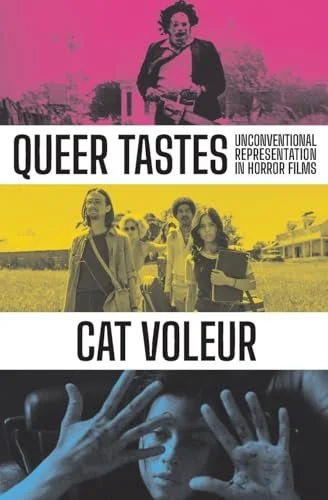
I say this, because this is 170pgs long; it’s not a tome of detailed articles delving into each film with an academic focus, although it is a scholarly work of non-fiction. It’s meant to be accessible to readers without a Film Studies background, and without a grounding in Queer Film & Literary Criticism. You can go into this and be entertained, as Voleur writes in an engaging, fun style about a subject she clearly loves and enjoys writing about, and also take away some genuinely thought-provoking points about each film under discussion.
I think my favourite thing about this book is Voleur’s voice – this reads like a personal book, and we are invited along on a whistlestop tour of 20 films that explore different facets of the queer experience, including queer fan reactions to films that are not, in themselves, explicitly queer, like Skinamarink, which Voleur includes for the queer community’s reaction to a movie about primal fear and trauma, and the short-lived adoption of the plastic toy phone at in-person queer events.
There is also a personal conclusion to the book at the end, and a full list of all the films referenced, not just the 20 covered by each section. Spoilers do abound, as there are summaries of each film included, but for me that doesn’t matter. I’ve seen a lot of the films on the list, and what other people think of as spoilers, I consider hooks. I don’t mind knowing what happens, if the reason I know the plot is because I’ve read something that has opened up a deeper appreciation of what I’m watching.
We move through time from the sapphic subtext and text of films like Rebecca (1940), Les Diaboliques (1955) and The Haunting (1963), to the 1970s, which covers a number of films like The Texas Chain Saw Massacre (1974), Suspiria (1977), and Hausu (1977). The 1980s opens up other aspects of queer experience and queer subtexts, from Possession (1981), and Deadly Games (1982), to The Toxic Avenger (1984).
The 1990s includes The Silence of the Lambs (1991), The Return of the Texas Chainsaw Massacre (1994), and Perfect Blue (1997). Martyrs (2008) is the only offering from the 00s, and then we get into the 2010s and 2020s to conclude. American Mary (2012) and The Perfection (2018) are the 2010s titles, then Huesera: The Bone Woman (2022), Skinamarink (2022), Scream (2022), and I Saw The TV Glow (2024) conclude our list.
Obviously, there are loads more Voleur could have included, and she talks about this and the process of inclusion and which films she wanted to discuss in her introduction and conclusion. This is never presented as a definitive list; it’s a very personal one, built around the online discourse and queer fan spaces with which Voleur is familiar, a year of watching horror films, and choosing ones that resonated with her the most.
I really enjoyed this approach, and it made me reconsider some of the films in a new light. It also introduced me to some that I had never heard of and made me reconsider ones I hadn’t liked the look of based on trailers and blurbs. There are full summaries and spoilers, but that doesn’t bother me, and if it doesn’t bother you, then I would go ahead and read it. If it does, this is your sign to watch the films listed before you dive in!
This is one for all Horror film fans, regardless of gender or sexuality – I think it’s a book anyone can get into, and offers some interesting perspectives in an accessible, readable, way. I’d recommend buying a copy to leaf through, highlight, and re-read a few times, along with watching the films in the full list at the back.
Purchase via
From Beyond Press / Foyles (UK) / Google Books
Review By C. M. Rosens
Instagram, Threads, TikTok: @cm.rosens
Bluesky: @cmrosens.com
I received an arc from the author for review consideration.