

Film Review: The Substance
Director: Coralie Fargeat
Genre: Horror
Format: Streaming
Purchase Link: Available on HBOMax
Long-time actress, Elisabeth Sparkles, is fired from her fitness job on primetime television due to her age. Nearing fifty, her producer is sick of her longevity and hungry for someone new and younger. After a freak car accident later that day, Elisabeth is introduced to “the substance,” which physically spawns a mid to late twenties version of herself named Sue. The catch? She must switch back and forth between these versions of herself every seven days or face rapid bodily decay in her original body. The only problem is that she can’t get enough of the success and power Sue obtains.
The Substance is a work of art. It’s finely crafted and knows exactly what it’s doing. I’m not a big fan of Demi Moore or Margaret Qualley, but they do what they need to do in their respective parts, making us feel the discomfort writer/director, Coralie Fargeat, wants us to feel. Fargeat is outstanding. Her style, approach, and tone work cohesively and seamlessly. The cinematography is sharp and cutting, the setting reminiscent of the 1980s. It is superficial, in a way, which reflects the motivations of our two main characters and the world at large.
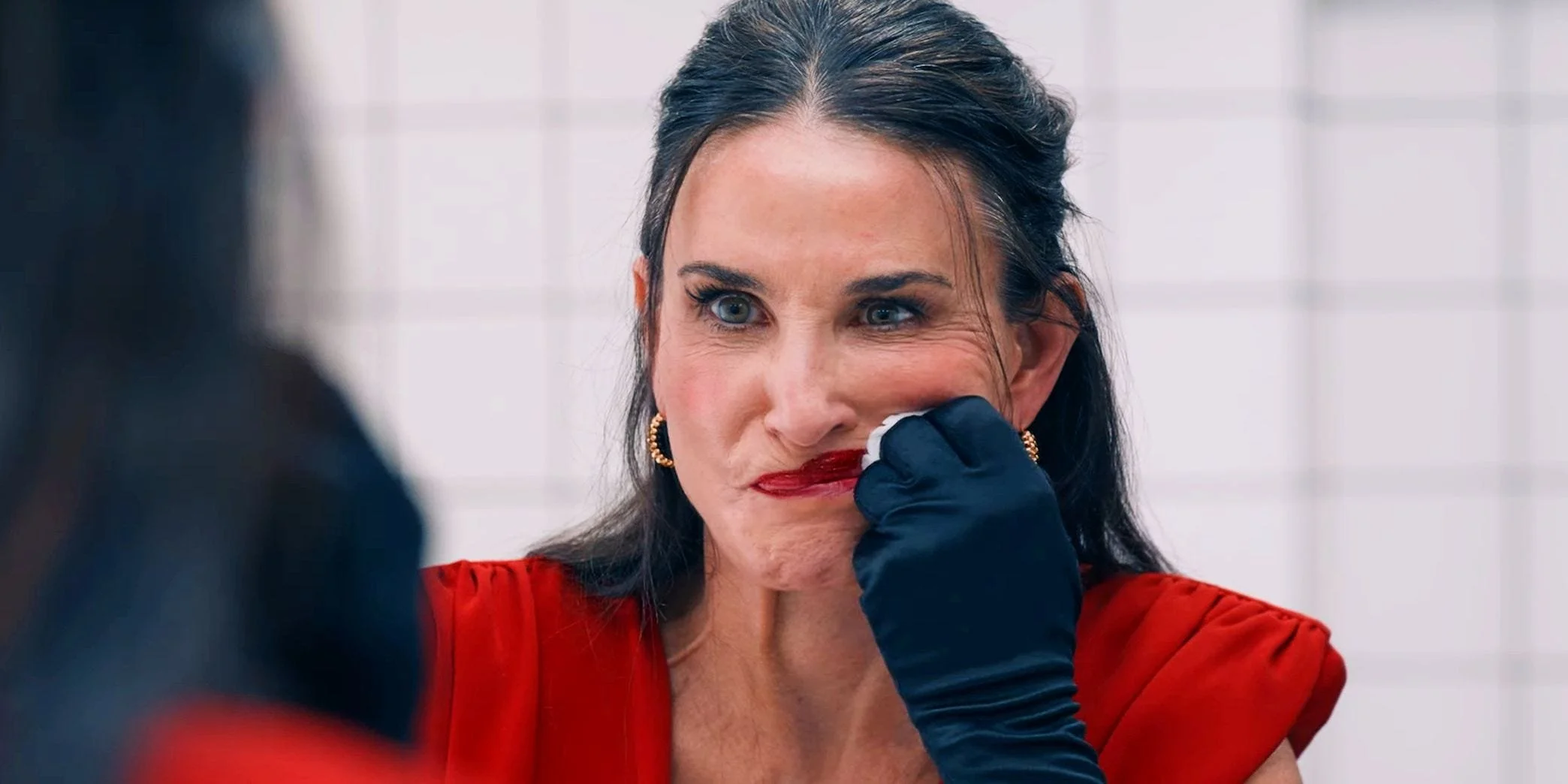
I was very emotionally impacted by the themes and ideas presented in this movie. Yes, it is body horror. But it’s also immediately and very clearly much deeper than that. What is the real horror here? Patriarchy and consumerism. The real horror? Men, and how far some women are willing to go to remain relevant in their eyes. I wanted to cry for Elisabeth because she really didn’t have to do this to herself. Yes, there is so much pressure to be young, wrinkle-free, thin, etc. But also, we have so much power to be who we are. We have so much power to decide that the patriarchal version of success – fame, youth, attention, power, ego – is not ours, and to find our own way.
Fargeat presents us with the idea that Sue gets whatever she wants as a young, beautiful woman. And sure, she gets what she’s told is valuable. But Fargeat also shows us that Sue has to play by the rules of those in power, who truly don’t care about her well-being, to get there. In doing so, she harms herself in ways that can’t be fixed.
As the movie goes on, the two women fail to take care of one another, and instead abandon one another for their own selfish desires. This is the greatest horror of being a woman. We see it everywhere; jealousy and ego breaking apart connections that could make us more powerful. We see it most painfully within ourselves, in our own internalized ageism and misogyny. “There is no she or you. You are both one,” says the mysterious substance dealer on the phone. He’s right, and it is immeasurably sad to watch the divide widen between Sue and Elisabeth.
The movie made me wonder whether I’d go back to a mid-twenties version of myself if I could. And I wouldn’t. Despite being thinner, sharper looking, and more bubbly, I have now a deep love for and knowing of myself that I wouldn’t trade for anything. I have unlearned so many of the harmful societal expectations that made me hate myself at twenty-five. I only wish more of us could get here – and earlier – in our lives.
I’m definitely down with what Coralie is saying here, though I’m not sure I'd ever watch this movie again. It is brutal, disturbing, and painful. 4/5.
Review By Chelsea Catherine
Chelsea Catherine’s Website