Halloween House Party: Knock Knock: Opening the Door to the Dark Half of the Year
Welcome back to Divination Hollow’s Halloween House Party! Every year, we celebrate Halloween with some specific content, giving you films, books, attractions and more that fit the spooky season from both contributors and guests. And if you want to celebrate with us, make sure you check out our Substack post for all the details on how to submit. Don’t forget to subscribe to be the first to hear about our events and open calls!
Knock, knock.
Samhain is at the door, and on the other side waits the dark half of the year.
For the Celts, every beginning started in the dark. The day began at sunset, and the year began at Samhain, the door into the darker half.
The Gaelic New Year
Samhain (pronounced SOW-in or SAH-win) is a Gaelic seasonal festival that marked the halfway point between the autumn equinox and the winter solstice. It is often called the Celtic New Year. It began at dusk on or around October 31 and most likely lasted about three days.
The Celts believed time began with darkness, which is why their new year opened with the dark half of the year. Samhain marked the turn from the year’s lighter half into its darker half, a season of rest, endings and ancestors that lasted until Beltane rekindled the light on May 1.
The Celts lived across much of Europe, but Samhain belongs to the Gaels, the Celtic peoples of Ireland, Scotland and the Isle of Man. Their Celtic cousins kept similar festivals of their own: in Wales it was Calan Gaeaf, the first day of winter. The word lives on today: Samhain is the modern Irish word for November, and Halloween night is Oíche Shamhna, “Samhain Eve.”
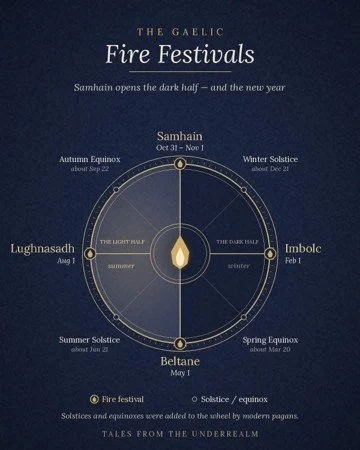
The Gaelic fire festivals. Image by Tracy J.
Samhain is one of the four great fire festivals of the Gaelic calendar, alongside Imbolc, Beltane and Lughnasadh. Each falls halfway between a solstice and an equinox, marking the turning of the seasons.
The Fires on the Hill of Ward
In Ireland, the Gaels gathered at the Hill of Ward, known in Irish as Tlachtga, in County Meath, where the great Samhain fires were lit. According to legend, the hill takes its name from Tlachtga, a powerful druidess who learned her magic from her father, the druid Mug Ruith, and who died on the hill. People still gather there each October 31 for a modern Samhain revival.
Excavations at the Hill of Ward have uncovered large amounts of burnt animal bone, a sign of feasting, along with traces of great fires. The earliest phase of the site dates to the Bronze Age, so it may point to ritual gatherings more than 3,000 years ago.
Nearby, on the Hill of Tara, the passage of the ancient Mound of the Hostages lines up with the sunrise around Samhain, as if the land itself were built to welcome the new year.
Bringing the Herds Home
Samhain also had practical roots in the pastoral year. It was customary to drive the cattle out to their summer pastures around May Day, at Beltane, and to bring them back home around Samhain in November. As the herds returned, the Gaels prepared for winter: the last crops were gathered, and the animals were kept for breeding or slaughtered for the months ahead. It was a time of feasting, with plenty of food and drink before the lean season.
When the Veil Grows Thin
Samhain was a liminal time, belonging neither to summer nor to winter. It was believed to be the moment when the veil between worlds was thinnest. This made it a powerful time for the druids to practice divination, since messages from the other side could pass through the veil with nothing to block them.
Spirits were stirred and free to move by their own will. In Irish mythology, the doors to the Otherworld stood open, and the aos sí, the fairy folk of the mounds, could cross into the human realm. Some said you could see the glow of their fires burning within the hills.
Apples, Hazelnuts and Love Divination
With the veil so thin, Samhain was the night to ask questions about the future, especially about love and marriage. Divination was done by the light of the great bonfires and at the family hearth.
Hazelnuts were placed side by side on the fire, one for each sweetheart. If the nuts roasted quietly together, the match would be a happy one. If they jumped away from the heat, trouble lay ahead. In Irish lore, hazel was the tree of wisdom, so its nuts were a natural way to look into what was hidden. In parts of Scotland and northern England, Halloween was even nicknamed “Nutcrack Night.”
Apples carried their own magic. In apple bobbing, people tried to catch an apple floating in water using only their teeth, and the first to bite one was said to be the next to marry. Others peeled an apple in one long unbroken strip and tossed it over their shoulder, hoping it would land in the shape of a future love’s first initial. In Ireland, Halloween was sometimes called “Snap-Apple Night.”
From Samhain to Halloween
When Christianity reached Ireland around the 5th century, the Church absorbed many of Samhain’s older traditions instead of erasing them. All Saints’ Day was eventually moved from May 13 to November 1, followed by All Souls’ Day on November 2, keeping this season of honoring the dead.
When the Irish emigrated to America, they brought their traditions with them. In Ireland, lanterns were carved from turnips to ward off wandering spirits. In America, the turnip became the pumpkin, and the jack-o’-lantern was born.
The door is open. What will you bring through it?
Sources
Samhain – World History Encyclopedia
Samhain Revival – Archaeology Magazine
About the Author
Tracy J writes gothic fiction and folklore at Tales From the Underrealm, where her serial The Necromancer’s Tide follows a waterway town whose tide no longer answers to the moon. She is also an attorney and a published children’s author.
This piece also appears on Tales From the Underrealm.