
Welcome to our annual Birthday Bash! Every November we celebrate DHR’s founding in November 2020 with a new theme. This year, we’re tackling Horror History. Historical Horror, history of horror, classic horror texts and more. Want to get involved? Just head over to our Substack and check out our call for submissions post!
A game first, an ancient book later
You are holding a deck of cards. The pictures look old: a tower struck by lightning, a hanged man, a wheel. Somewhere in the little white booklet, or on the website that sold you the deck, you may have read that these images came down from ancient Egypt.
Here is what the record shows. Cards of this kind are documented in fifteenth-century northern Italy, where they were used to play a game. The ancient Egyptian origin story appears in print in a book published in Paris in 1781, more than three centuries after the earliest references to the cards themselves.
This is not an exposure, and nobody is being caught out. The interest lies in the gap between those two dates, and in what people did with that gap once it existed. So it is worth being clear about three things as we go: what is documented, who said what, and what remains genuinely uncertain.
What the earliest cards were for
The earliest references to these cards date to the 1440s and 1450s, in the cities of northern Italy. Tim Husband, writing for the Metropolitan Museum of Art, describes what they were for: a trick-taking game, played with the standard Italian suits, to which had been added an extra run of picture cards outranking the suits, along with the Fool.
That is a game with a structure a modern card player would recognise, and the structure matters here. The trumps were not a mystical appendix bolted onto a pack. They were the cards that took tricks.
The finest surviving examples include the Visconti and Visconti-Sforza cards, attributed to the workshop of Bonifacio Bembo, the Milan court painter. The Met notes that the older Visconti pack is thought to have been made for Filippo Maria Visconti, duke of Milan. These are painted, gilded objects made for a court, not cheap printed sheets.
Husband makes one further point worth holding on to. The game was already complicated by the time it enters the written record, which suggests it had begun evolving earlier in the century. That keeps the origin open rather than closing it. There is no documented day, no single inventor and no founding city that the evidence will support.
What the surviving cards do not show is fortune-telling. Occult and divinatory associations attached themselves to tarot later. They were not the original function of these objects.
1781: two essays in one volume
The turn happens inside a book about the ancient world. Volume eight of Antoine Court de Gébelin's Monde primitif, published in Paris in 1781, is the object shown in the Morgan Library and Museum's Occult Tarot exhibition, where the curator Josh O'Driscoll sets out what it argued.
Court de Gébelin looked at the imagery of the tarot and read it as the remains of an ancient Egyptian book of magic: sacred knowledge that had survived, in his account, precisely because it had been disguised as a game of cards. The distinction matters. This was his interpretation of pictures he was looking at, not a discovery and not a finding. By the Morgan's account, he first came across the cards while visiting a friend outside Paris.
The story is usually compressed at this point, with everything credited to one man. It should not be. A contribution from the Comte de Mellet followed Court de Gébelin's essay in the same volume. Mellet identified the cards with the Book of Thoth, and he was among the first to suggest they could be used for divination, setting out early instructions for doing so. The Egyptian frame and a set of divinatory instructions both appear in that 1781 volume, but they come from two pens, and the practical instructions are Mellet's.
Between them, the two essays supplied a theoretical foundation that later occult writers went on to build upon.
English readers can find Donald Tyson's translation of Court de Gébelin's essay online, though Tyson himself describes his version as rough and warns against relying on it for accurate quotation. That is reason enough to paraphrase rather than quote.
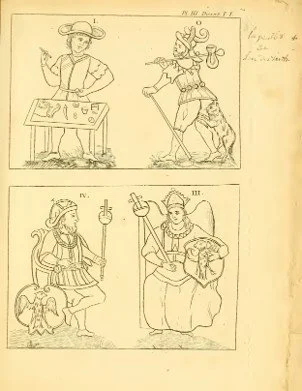
Plate III from Antoine Court de Gébelin's Monde primitif, volume 8, Paris, 1781: the Magician, the Fool marked with an O, the Emperor and the Empress. Public domain, via Wikimedia Commons.
What 1781 did not invent
There is a tidier version of this story in circulation, in which nobody ever told a fortune with these cards until a French scholar said Egypt. The evidence does not support it.
Giordano Berti has written about a discovery made by Franco Pratesi in 1989: a sheet from Bologna listing divinatory meanings for the Bolognese cards. Berti's account dates the sheet to around 1750 to 1760, citing Pratesi's 1989 article and a Bologna library catalogue. This is a secondary report. I have not seen the sheet itself or Pratesi's original article, and the dating is approximate rather than fixed.
The conclusion to draw is narrow, and worth stating as narrowly as it deserves. Reading these cards for divination was not conjured out of nothing in 1781. Something of the kind was being written down in Bologna beforehand. What the sheet does not do is establish an earliest date, or tell us how far the practice had spread, or who was doing it.
What follows 1781 is better documented. Etteilla subsequently brought tarot into his cartomancy work, and the ideas set out in those two essays became a foundation for the occult reinterpretation that ran on through the following century. The V&A's history of tarot notes that the Egyptian origin claims made in the late eighteenth century remain unproven.
The pictures on today's decks
Move forward to 1909 and the Rider-Waite-Smith deck, with artwork by Pamela Colman Smith. The V&A calls it one of the most recognisable tarot decks still in print, and notes that many decks still use the symbolism Smith created.
Consider what that means as a stack. A deck published in 1909 carries an origin story published in 1781 about a game documented in the 1440s. Three layers, spread across almost five centuries, with three quite different sets of intentions. Each layer is legible if you look for it. The suits and the trumps are the game. The Egyptian frame is the eighteenth century. The pictures on many of today's decks are Edwardian.
The stacking has not stopped. As the V&A shows, contemporary artists keep reimagining the same visual language for their own purposes. That is not decadence or dilution. It is the pattern this object has followed from the beginning.
What an invented past is for
What follows is interpretation, offered as one reading rather than as research into what tarot readers believe.
An origin story works as a set of instructions for attention. Tell someone that a picture is a fragment of something very old and very deliberate, and they will look at it longer, and differently, than they would look at a card that simply takes a trick. The 1781 essays handed later readers that instruction, and it was taken up.
The documented history is not the lesser story either. A duke of Milan commissions gilded cards from a court painter's workshop. A game develops, with trumps in it and a Fool. More than three centuries later a scholar visiting a friend outside Paris looks at a pack of them and sees Egypt. For readers who like strange things, that is already strange enough.
Knowing the dates obliges nobody to put the cards down. People were writing meanings for these pictures in Bologna before Court de Gébelin ever saw them, and they have gone on doing it in every century since. Nor does it require anyone to keep the Egyptian frame. It simply makes the object in your hands older, stranger and more interesting than the booklet suggests.
About the author
Selene Marsh writes about spirituality, folklore and modern witchcraft at Myriapath.
Sources
Tim Husband, "Before Fortune-Telling: The History and Structure of Tarot Cards", The Metropolitan Museum of Art, 8 April 2016. https://www.metmuseum.org/perspectives/tarot-2
"Occult Tarot", Morgan Library and Museum, exhibition stop 311. https://www.themorgan.org/exhibitions/online/tarot/11
Rebecca Billingham, Ruth Hibbard and Josephine Nardecchia, "A history of tarot cards", V&A. https://www.vam.ac.uk/articles/tarot-cards
Antoine Court de Gébelin, "Of the Game of Tarots", translated by Donald Tyson. https://www.hermetica.info/GameOfTarots.pdf
Giordano Berti, "The oldest method of reading the Tarot", 27 February 2020. https://rinascimentoitalianartenglish.wordpress.com/2020/02/27/the-oldest-method-of-reading-the-tarot/