

Pride in Horror Fiction: The Yōkai, Chapter 2: The Aftermath by Jon O’Bergh

In the previous chapter: A gang of yōkai demons appeared before college student Asami with a strange demand; she is to tell them a ghost story each night in exchange for her life.
I sat in stunned silence on the floor for several minutes, letting the reality of the incident sink in. Eventually, I rose to pick up the scattered objects. The rain grew stronger, clattering on the roof like a thousand geta-clad feet. I went to the window to see icy pellets bouncing as they hit the road. Nothing looked amiss on the street. Across the way, the light from a vending machine glowed, oblivious to the havoc that had occurred in my house. I couldn’t blame what had happened on an earthquake or come up with some other rational explanation. It was easy to dismiss such occurrences when they happened to other people. We say to ourselves that they must have been dreaming while half-awake, or imagining things in the dark, or suffering hallucinations brought on by stress. But this was absolutely real. What I had seen was as lucid and concrete as anything else: the sound of the hail, the glow of the vending machine, the book I held in my hand.
As I looked around the room, I still felt unsettled. I needed human company. I finished putting things in order and decided to go next door to see if Tammi and Zoe, university students from overseas, were home. For the moment, though, I decided not to share my experience with anyone.
Tammi Utahara was a violinist enrolled in the music program. She had been born in Japan, then raised in the San Francisco Bay Area after her father accepted a teaching position at Stanford University. She had returned to Japan for college. One warm, autumn day a few months back, I heard someone practicing a Mozart violin concerto. The windows were open and I just sat at my desk, listening. It wasn’t until a few days later I actually met Tammi, when we both arrived home at the same time. She smiled at me and said, “Hi.” I asked who had been playing the violin, and she said it was her. It surprised me that such assured playing came from a person with her petite stature. Her technique was forceful, yet still conveyed grace and tenderness befitting Mozart.
We learned about each other’s backgrounds. She was fascinated to hear I was studying yōkai—not something you expect to encounter in talking to a stranger, especially a woman. I admired the way her hair fell in graceful waves down her shoulders, so different from the way I wore my chin-length hair partially pulled back with a clip in a half-up, half-down style. She said we should get together sometime. I’m used to hearing people use that phrase when they don’t really mean it, so I was surprised when a few days later she showed up at my door with her housemate Zoe and they invited me to join them for coffee at a neighborhood cafe.
Zoe Alvarez had come on a student visa from Toronto to study art. Her shoulder-length hair transitioned from dark roots to magenta, like she had dipped the strands in a can of neon pink paint. Her round face conveyed kindness, but I could sense a willingness to be confrontational if needed; a very different approach from my tendency to seek harmony no matter what. Japan had always appealed to her because of her interest in anime and manga. I had been exposed to a lot of anime and manga growing up, and as part of my research since they often incorporated yōkai—manga like Shigeru Mizuki’s Kitarō yōkai boy series and Hayao Miyazaki’s Spirited Away movie—so we had a lot to talk about.
I knocked on the door, huddled against the cold. Tammi let me in.
“I hope I’m not disturbing you,” I said.
She shook her head. “Not at all.”
I told her my house had shaken a while ago and I thought it might have been an earthquake. She hadn’t felt anything. I said it was probably a minor tremor and laughed a little too loudly, still nervous from my encounter. She asked if I wanted some tea. I nodded.
We talked about the weather as she heated some water. Carefully, I brought up the subject of yōkai and asked if her parents had ever mentioned them.
She laughed. “Not really, unless you count some nursery rhymes. But when my grandmother visited us, she shared a story with me. She knew someone who claimed to have actually seen a yōkai. This friend was walking in the mountains and came upon a small, monkey-like creature sitting on a stone. But it wasn’t a monkey. The friend called out and it responded by echoing what he said. They just stared at each other for a minute, then it skittered off into the brush.”
“Probably a yamabiko. The spirit of the valley echo.”
I pressed further, wanting to know if anything came about because of the encounter, but she had nothing to add. I suggested that her grandmother was probably offering an entertaining explanation to a child for how an echo happens, the way some folk legends serve to explain natural phenomenon.
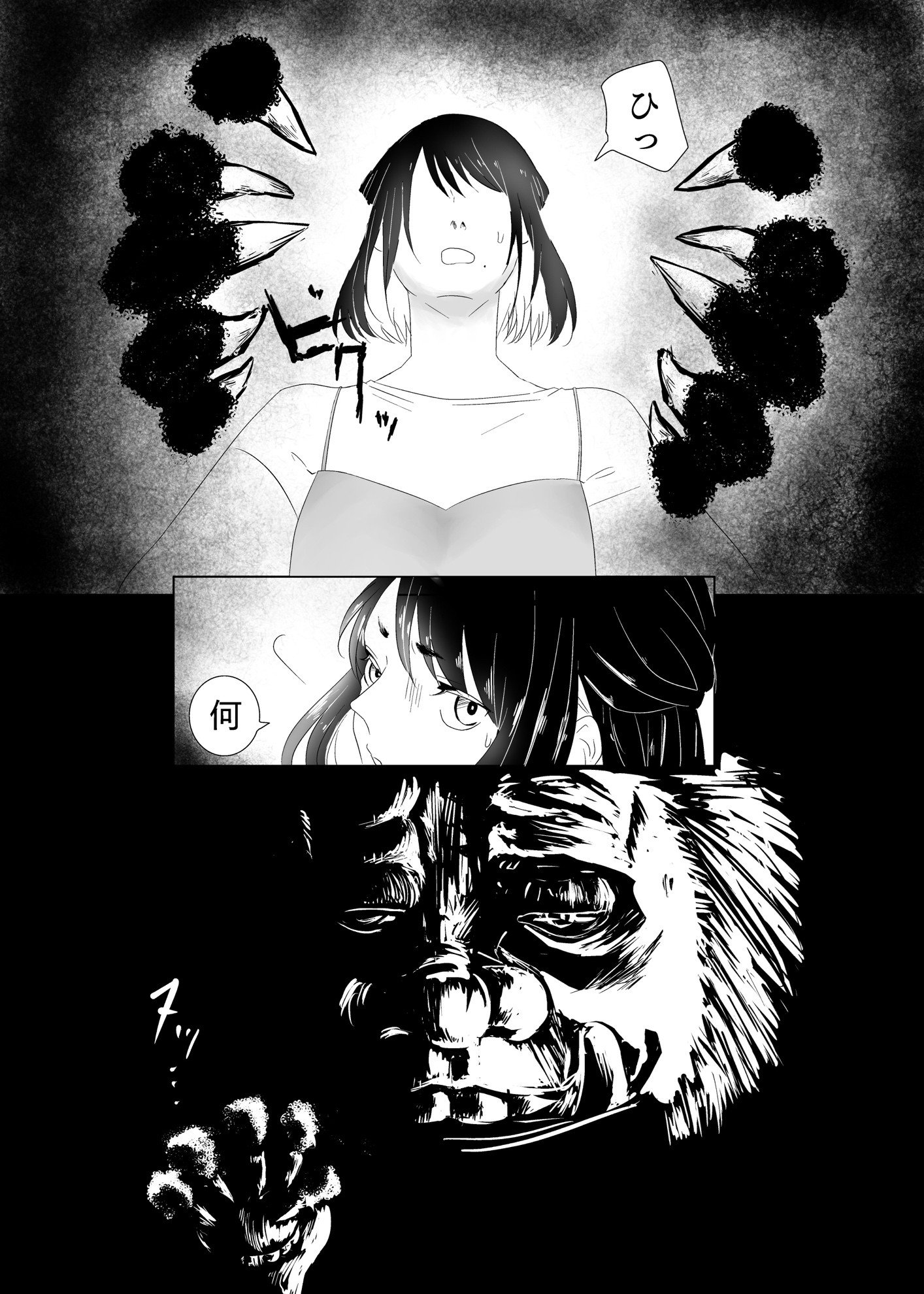
Asami and the Yōkai illustration by Samatsu – copyright by Samatsu, used with permission by the artist for non-commercial purposes
Tammi prepared two cups of tea and we sat down, talking further about yōkai. Part of me wanted to share what I had seen, but I suppressed the urge. Perhaps if we had been close friends I would have risked revealing the truth. Since she was a musician, I thought she might appreciate hearing about the biwa bokuboku, an abandoned stringed instrument that reportedly sits alone in a room and plays sad music, sometimes even dancing through an empty house making music as it goes. This got her laughing.
“What about a Stradivarius violin?” she asked. “Could that become a bokuboku?”
“I don’t see why not.”
Her laughter calmed me somewhat, and my mood lightened.
The door opened, and Zoe walked in, water running off her umbrella. “My God, it’s wet out there.” She stashed the umbrella in a stand and greeted me.
Tammi told her not to worry if the violin started playing sad music on its own or grew legs and danced about. Zoe gave her a quizzical look. I explained that it was a type of yōkai.
“So, you two have nothing better to do on a rainy evening than sit around talking about dancing violins?” She slipped off her shoes at the genkan, then came over to the sofa and plopped down.
I told Zoe I’d come over because I thought there had been a small earthquake, but she had felt nothing either. Even if I convinced myself I had imagined the yōkai, something had certainly knocked things askew in my house.
We talked about school, projects, our families, the best places to buy inexpensive clothes. Zoe announcedshe had asked two of their friends over and invited me to stay for dinner. I’d met them before, if only briefly. Since I wasn’t ready to face the solitude of my house, I welcomed the invitation.
Half an hour later, Jiro Masaki and Josh Thorne arrived with take-out food.
The sofa groaned as Josh sank into its cushions. With his legs spread far apart, he surveyed the room like a king. “Let’s get some music going, liven up this mausoleum,” he commanded.
Zoe put on some music low in the background while Tammi brought out plates and glasses. The friends chatted and laughed as they dished food onto their plates. I smiled at the pleasantries but kept mostly silent, watching the group dynamics. Josh commandeered most of the attention, which annoyed me. I always resented alpha males who flaunted their privilege without regard for others’ needs, vacuuming up the energy in the room. Jiro, on the other hand, listened carefully to those around him. I imagined he could take charge if the need arose but preferred not to impose his will. The contrast between the two men could not have been starker. I wondered how they could even be friends, but since they were taking the same software development and gaming courses, they probably appreciated each other’s intellectual strengths. Josh had come from America, Jiro from a small town in Iwate Prefecture.
Zoe’s interaction with Josh grew flirtatious. There was some chemistry there, but all I could think was what an odd couple they would make, a combination of diesel gasoline and mayonnaise. Tammi seemed the least impressed with Josh’s temperament. I caught her frowning several times at things he said that made the others laugh. She would just look down at her bowl and scoop up a bit of rice with her chopsticks. I cringed every time Josh said “bro,” especially when he directed it at me and the other women. Such a jerk.
Tammi announced that I was doing research on yōkai.
“You mean, like, Japanese demons?” said Josh, leaning forward with interest. “That’s awesome, bro.”
I corrected Josh’s perception, explaining that “demons” was far too limiting a term and didn’t capture the full scope of these supernatural entities. Yōkai covered the gamut of behavior from helpful to mischievous to sinister. They represented a wide range of supernatural occurrences that included ghosts, goblins, invisible walls, demons, anthropomorphic household items, strange hybrid animals, mysterious lights, and so forth. Anything, it seemed, could take on the spirit of a yōkai, especially very old objects. But the most worrisome were those that terrorized and killed people.
Zoe asked me if I believed that yōkai existed. I looked down at my plate, ashamed to admit what I now knew to be true. Naturally, I lied and said no, they were just folktales like similar myths in cultures around the world.
“I’m not superstitious at all,” said Jiro. “But there are plenty of people who still believe in yōkai where I come from.”
Tammi rose to retrieve her violin. “There’s a nursery rhyme about Teru Teru Bōzu, the small white cloth ghosts people hang from the eaves of houses and wish for sunny weather. My mother taught it to me when I was a girl.” She positioned the violin beneath her chin and readied the bow. “The practice came from the story of Hiyoribo, who brings sunny weather in the summertime.” She looked at me. “You probably know it, Asami. Maybe Jiro does, too. The lyrics urge Teru Teru Bōzu to make tomorrow a sunny day; if he makes the wish come true, we’ll drink sweet sake, but if not, we’ll chop off his head.” She began playing the bouncy melody, which I remembered from my childhood.
Once she finished, I noted how it was a bit disturbing for children to be singing about alcohol and murder, which made everyone laugh. Josh added that Western nursery rhymes like “Three Blind Mice” were not much better—the one thing he said that I could agree with. Still, the song made me wonder whether my head would be chopped off if I didn’t come up with a good story to tell to the yōkai. I heard the lyrics in my head as if the yōkai were singing to me: Asami-san, Asami-san, make tomorrow’s story a good one. If I’m amused, we’ll drink sweet sake. But if I’m not, I’ll chop off your head.
About the Author
Jon O’Bergh is a musician and author of three horror novels. His latest novel The Yōkai is currently offered for free in weekly installments on Substack. Out Front Magazine described his novel Shockadelica as “a book that must be on your to-read list,” and Aurealis Magazine named it “Reviewers’ Pick of 2022.” He has also released over a dozen albums in a variety of styles, including the critically acclaimed album 13 Witches.